

Automatic Irrigation in 2026: Cost, ROI & Expert Pricing
The Myth of Price per $m^2$: Why Experts Won't Give a Quote Over the Phone
One of the most frequent questions we encounter during turnkey realizations is: "What is the price per square meter of irrigation?" The answer is direct and often surprising: Price per $m^2$ does not exist in professional irrigation. If a contractor offers you a flat rate based solely on area without seeing your plot or a technical design, you should proceed with extreme caution.
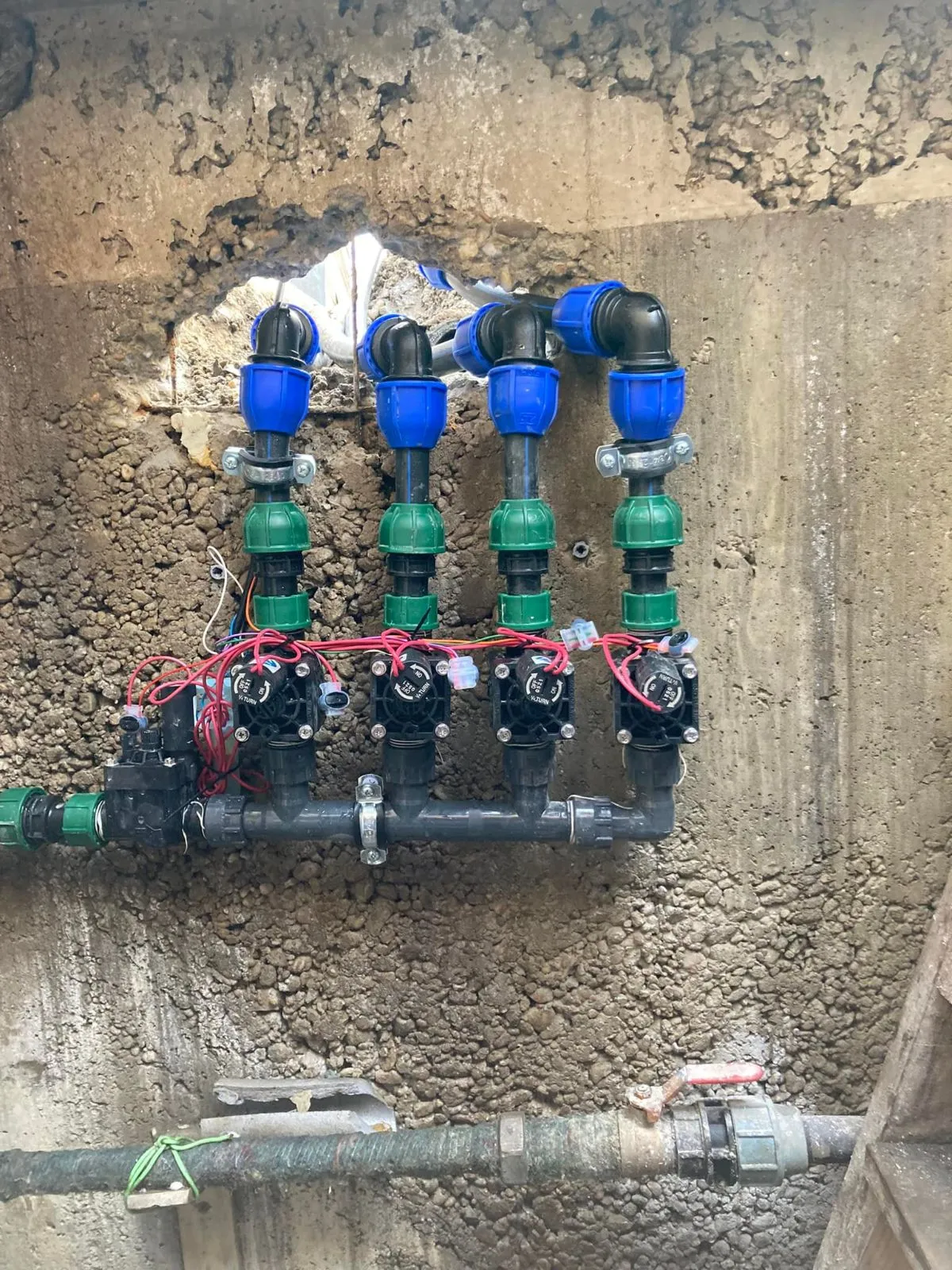
In 2026, the price of an automatic irrigation system is primarily determined by the complexity of the terrain, not its raw size. Consider two plots of $500\ m^2$. The first is a clear, rectangular lawn. The second is a complex garden with islands, walkways, rockeries, and various types of planting. Although the area is identical, the second plot requires twice as many sprinklers, more electromagnetic valves, and more intricate piping. The more "complex" the garden, the more technically demanding—and logically more expensive—the system becomes.
Components of Irrigation Pricing: The Formula for a Successful Realization
When budgeting for a turnkey system, you must account for three fundamental components that make up the final invoice:
- Materials: High-quality components (sprinklers, nozzles, valves, controllers, sensors, pipes, and fittings).
- Labor and Professional Assembly: Excavation, component installation, software configuration (e.g., Hydrawise), pressure testing, and precise nozzle calibration.
- Technological Infrastructure: Pumping technology, filtration, or connection to the water source (well vs. municipal supply).
The Labor-to-Material Ratio: Why Experts Charge 1:1
In the irrigation segment, there is an unwritten rule regarding the ratio of labor costs to material costs. You will find various offers on the market, usually in these ranges:
- Ratio 1 : 0.5: Often offered by seasonal workers or firms without deep specialization. However, lower labor costs often result in unprofessional pipe laying (too shallow) or poor hydraulic design, leading to expensive future repairs.
- Ratio 1 : 1 and above: The standard for true experts and specialized firms. In 2026, it holds true that professional turnkey installation requires an investment in labor at least equal to the cost of materials.
Why is this the case? An expert isn't just selling you "buried pipes." They are selling you a precise hydraulic calculation, a warranty on the entire work, meticulous setting of precipitation rates, and a guaranteed system lifespan of over 15 years. For complex and segmented plots, labor costs may even exceed material costs because installation in narrow spaces or among expensive mature planting is extremely time-consuming and technically demanding.
Crucial Warning: Cheap labor is the most expensive investment in irrigation. If the system is installed unprofessionally, the first winter or water pressure fluctuations can cause damage that far exceeds any "savings" made on the initial installation.
Return on Investment (ROI): When Does the System Pay for Itself?
Investing in turnkey automatic irrigation is not just a luxury expense. It is a data-backed economic decision. We calculate the ROI of a system in 2026 through three main factors:
- Water Savings: Thanks to smart sensors and night-time cycles, you use 30% to 50% less water than with manual hose watering. With rising water and sewage rates, this is a significant annual saving.
- Protection of Landscape Investment: A new lawn and ornamental planting for a family home cost thousands of dollars. One extremely dry summer without irrigation can wipe out this investment. Irrigation is the "insurance policy" for your garden.
- Property Value Increase: A home with a functional, professionally installed irrigation system has a higher market value and is demonstrably easier to sell.
The average financial return on a professional system, when accounting for water savings and the owner's valuable time, ranges between 3 to 5 seasons.
Terrain Complexity as the Main Price Driver
When calculating a turnkey price, we always look at the number of required zones (sections). The more complex the garden:
- The more electromagnetic valves are needed for proper pressure distribution.
- The more meters of piping and fittings are used to navigate obstacles.
- The more powerful the controller (with a higher number of zones) is required.
Therefore, irrigation for a small but complex front garden with many shrubs can be more expensive than for a large but empty football pitch.
Conclusion: Quality That Pays Off
The price of turnkey automatic irrigation in 2026 reflects technological progress and the value of expert labor. If you are looking for a solution that will function without failure for many years, look for a partner who does not offer suspiciously cheap labor but guarantees quality at a 1:1 ratio to materials.
Your garden is a living organism, and automatic irrigation is its circulatory system. Saving on expertise in this case is equivalent to gambling with the entire beauty and value of your home.